

 Current position >About Us
What is an Annubar Flow Meter: Averaging Pitot Tube Differential Pressure Basics
Quick Answer: An Annubar flow meter is a type of averaging pitot tube that measures the flow rate of liquids, gases, and steam by sensing the difference between impact pressure and static pressure across a pipe cross-section. It creates a permanent pressure drop much lower than an orifice plate, saving thousands of dollars in pumping costs each year on large pipe sizes like DN300 and above. You can use it for steam feed lines in a textile factory, cooling water in a petrochemical plant, or compressed air in an automotive assembly line, and get a stable 4-20 mA HART signal without cutting the pipe.
One Sensor, Multiple Pressure Ports
Most engineers learn about pitot tubes in school, then forget about them. A standard pitot tube measures velocity at a single point. An Annubar is different. Its sensing bar goes across the entire pipe diameter, and multiple sensing ports face upstream. Each port sees a local velocity pressure. Inside the bar, an averaging chamber blends these values, so the output represents the true average flow profile, not just one spot near the wall or centerline. That is the simple but powerful reason why an Annubar can hold ±0.5% to ±1% of rate accuracy in fully turbulent flow.
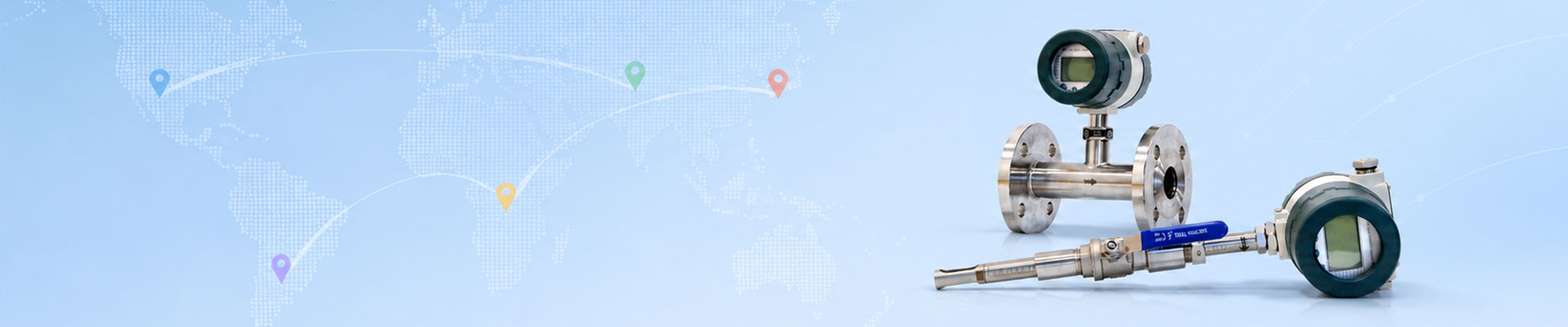
Silver Automation Instruments supplies insertion-type averaging pitot tubes with direct-mounted differential pressure transmitters. The sensor body is often made of 316L stainless steel or Hastelloy C for corrosive gases. You will see models with a T-shape or bullet-shaped profile that sheds vortices at a fixed point to isolate the low-pressure port from turbulent wake mess. In practice, this design keeps the DP signal steady even when the pipe Reynolds number changes a lot.
How the DP Signal Becomes a Flow Rate
The fundamental math is the same as any differential pressure device. Flow rate is proportional to the square root of the differential pressure. If you read 10 mbar at 50 m³/h, you will see 40 mbar at 100 m³/h. A multivariable transmitter adds PT100 temperature input and an absolute pressure sensor, and it can output mass flow of steam in kg/h directly via 4-20 mA HART or Modbus RTU. We have seen a biomass boiler plant in Thailand install six DN400 Annubars with integral temperature compensation and cut their saturated steam measurement cost by 60% compared to a full-bore vortex meter solution.
Because the sensor insertion depth can be supplied to match your exact pipe schedule, even large pipe ID deviations do not cause big errors. A 42-inch cooling water pipe at a desalination plant in Saudi Arabia does not need a huge spool piece. You simply weld a 1.5-inch or 2-inch mounting fitting, insert the probe through a ball valve hot-tap assembly, and lock it in place. That is a full weekend of downtime saved.
Where an Annubar Outperforms an Orifice Plate
Orifice plates are cheap to buy and expensive to own. Their permanent pressure loss is around 60% to 80% of the measured DP. An Annubar produces only 5% to 15% of the measured DP as permanent loss. Take a DN500 natural gas pipeline running at 20 bar. Switching from an orifice to an averaging pitot tube can save an operator over 15 000 USD in compressor energy over five years. That number is not theory. A gas distribution company in Argentina verified it across four metering stations.
There is another pain point. Orifice plates collect dirt upstream and the sharp edge wears out in wet steam or slurry. An Annubar with a stepped-shape sensor does not trap solids and can handle some entrained liquid droplets. We recommend it for saturated steam with dryness fraction above 0.95, or for air with trace oil mist, but not for raw sewage with rags and stones.
Typical Accuracy and Real-World Limitations
On the spec sheet you will see accuracy of ±0.5% of rate if the flow profile i