

 Current position > News detail
『Normal values for peak flow meter: Height and Gender Base Calculations』Related information(flow rotameter|digital flow meter|balo meter|hydraulic flow meter|volumetric meter|positive displacement meter|pitot tube flow meter|displacement meter|cfm meter|variable area flow meter|inline flow meter|differential pressure flow meter|calibrated flow meter|velocity meter|paddle wheel flow meter|oval gear flow meter|anemometer hvac|multiphase flow meter|doppler flow meter|thorpe tube flowmeter|heat flow meter)
Industrial Peak Flow Meter: Normal Values and Calculation Based on Pipe Size and Fluid Properties
Quick Answer: In industrial plants, peak flow values are not based on height or gender. Medical peak flow meters do use those variables for lung function prediction. For process engineers, normal peak flow is determined by pipe diameter, fluid type, pressure, and temperature. A DN50 air line at 7 bar typically sees peak flow rates of 200 to 400 Nm³/h. A DN100 water pipe often handles peaks up to 100 m³/h. Keep reading for real reference tables that you can use on site today.
Medical Peak Flow vs. Industrial Peak Flow
Doctors use small handheld peak flow meters to measure how fast a person can exhale. Normal values for those devices rely on the patient’s age, height, and gender. A 180 cm tall male often has a predicted peak expiratory flow around 600 L/min. A female of the same age and height typically shows 480 L/min. Those numbers are not relevant for a chemical plant or a water treatment station.
In industry, peak flow describes the highest instantaneous flow rate that a pipeline or a piece of equipment sees during normal operation or during a surge. The principles are different. Pipe geometry, fluid density, and pressure drop dictate the numbers. No operator looks at height or gender to size a flow meter. Instead, you check the pipe ID, the maximum working pressure, and the fluid state.
What Actually Defines Normal Peak Flow Values in a Plant
A textile factory in Vietnam asked us last month for a peak flow meter on a compressed air header. Their system ran normally at 150 Nm³/h. Twice a shift, three large valves opened at the same time. The flow spiked to 380 Nm³/h for 45 seconds. That spike is the peak flow. We see similar patterns in food and beverage steam lines and in desalination plant brine transfer pipes.
Practical normal values for peak flow are not universal constants. They depend on five things.
Pipe size (DN). A DN25 pipe simply cannot pass the same peak as a DN80 pipe, no matter the pressure. Fluid type. Gas velocities can run much higher than liquid velocities. Air at 7 bar can move at 20 to 30 m/s. Clean water is usually limited to 2 to 3 m/s to avoid water hammer. Pressure and temperature. Higher pressure packs more mass into the same volume for gases. Density changes shift the peak mass flow reading even if the volumetric flow stays the same. Process upsets. Batch feeding, pump changeovers, and fast opening solenoid valves create short duration peaks. Safety limits. A flare header might see massive peaks that only last seconds. The meter must survive that.
Reference Table for Air Peak Flow by Pipe Diameter
Based on field data from Southeast Asian manufacturing plants, here are the typical peak air flow values at 7 bar and 25 °C. These numbers are for compressed air systems in normal production mode. Peaks are assumed to last less than one minute.
DN15: 25 to 45 Nm³/h
DN25: 70 to 130 Nm³/h
DN40: 150 to 260 Nm³/h
DN50: 280 to 450 Nm³/h
DN80: 700 to 1100 Nm³/h
DN100: 1200 to 1800 Nm³/h
DN150: 2500 to 3800 Nm³/h
These are not theoretical maximums from a pipe sizing chart. They are real operating peaks we have measured with vortex flow meters and thermal mass flow meters on customer sites in Thailand, Indonesia, and Mexico. For saturated steam, cut these numbers by about 60% at the same pipe size because steam density is lower and velocity limits are stricter.
Reference Table for Water Peak Flow by Pipe Diameter
For industrial water lines running at 3 to 4 bar, the peak flow rates look very different. The normal peak is usually 1.3 to 1.6 times the average flow. In water treatment plants in the Middle East, we see these typical peaks.
DN25: 2 to 4 m³/h
DN40: 5 to 9 m³/h
DN50: 10 to 18 m³/h
DN80: 25 to 45 m³/h
DN100: 50 to 90 m³/h
DN150: 120 to 200 m³/h
If your fluid is viscous, like heavy fuel oil or glucose syrup, the peak numbers drop sharply. An oval gear flow meter on a DN50 waste oil line might only register a peak of 3 to 5 m³/h because viscosity limits pump speed and pipe velocity. In practice, most engineers skip the theoretical formulas and check the pump curve and the pipe pressure drop charts instead.
How to Calculate Peak Flow for Your System
There is a simple field method that works i
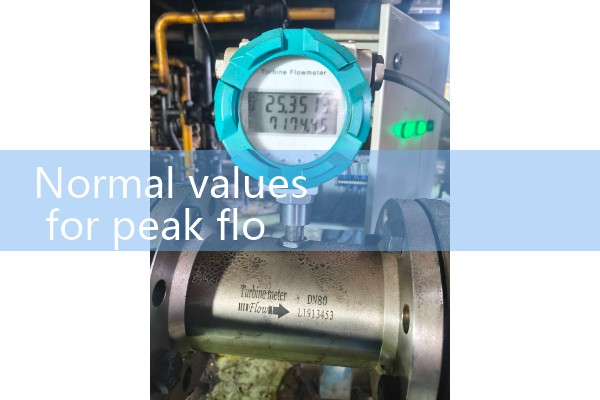
One more real world tip. A paint manufacturer in Malaysia asked us why their DN40 air line always tripped the flow switch at 180 Nm³/h. The table says that is within the normal peak band. When we checked, their actual operating pressure was only 5.5 bar, not 7 bar. At lower pressure, the same mass flow takes up more volume. That pushed the effective velocity higher. We swapped in a vortex flow meter with temperature and pressure compensation. The peak reading then stayed accurate and the nuisance trips stopped.
Flow Meters That Handle Peak Flow Spikes Without Damage
Not every flow meter can cope with a sudden 200% flow spike. We have seen plastic rotameters explode on compressed air lines. We have seen small turbine meters shear the bearings. For reliable peak flow measurement, choose an instrument with no moving parts and a wide turndown ratio.
Vortex flow meters from Silver Automation Instruments handle velocity spikes up to 80 m/s on gas. They work well on steam and compressed air headers. Electromagnetic flow meters on water lines stay accurate even during short overrange conditions. If the peak flow contains dirt or bubbles, the magmeter will still read correctly. For dry gases like nitrogen or biogas, a thermal mass flow meter gives direct mass flow and can be ordered with a range up to 200 Nm³/h in a DN50 insertion model.
We ship these meters to over 40 countries. Last quarter, a water distribution engineering company in Chile installed 22 electromagnetic flow meters on a potable water network. They set the upper range value 30% above the calculated peak. The system has run without signal clipping for six months.
FAQ About Peak Flow Normal Values and Measurement
1. Do medical peak flow meters and industrial peak flow meters work on the same principle?
No. Medical peak flow meters use a spring loaded piston or a pressure sensor to measure exhaled air velocity. Industrial peak flow measurement relies on vortex shedding, thermal dispersion, or electromagnetic induction. The only common point is the word peak flow.
2. Why does a medical peak flow chart use height and gender but industrial charts use pipe size?
Human airway resistance scales with lung volume, which correlates with height and gender. A pipe does not have a gender. Pipe flow resistance scales with internal diameter and surface roughness. That is why industrial tables are built around DN and fluid properties.
3. Can I use the same flow meter for normal flow and peak flow on one line?
Yes, if the turndown ratio is wide enough. A Silver Instruments vortex flow meter has a turndown of 20:1 for gas. That means if your normal flow is 50 Nm³/h and the peak is 400 Nm³/h, the meter still reads both within spec. Always specify the peak value when you request a quote.
4. My peak flow happens for only 2 seconds every 15 minutes. Will the meter catch it?
Most digital flow meters sample several times per second. Vortex meters refresh at 3 to 5 Hz. Thermal mass meters are slower at 1 Hz but still detect brief peaks if the time constant is set correctly. For extremely short peaks, use a pressure transmitter with a fast response to cross check.
5. What information should I send to get a peak flow meter recommendation?
Send us your fluid type, minimum and maximum flow rate, pipe size (DN), operating pressure (bar) and temperature (°C). If you already know the peak duration in seconds, include that as well. We will propose a meter that covers both normal and peak conditions without over sizing.
Contact Silver Automation Instruments
Need a flow meter that handles peak flow conditions in your plant? Send us your pressure (bar), temperature (°C), pipe size (DN), and flow range. Our engineers in Nanjing will reply with a specific model and price within one working day.
Email: [email protected]
Tel: +86-25-68650347
Whatsapp: +86-25-52155837
WeChat: +86 15365082610