

 Current position > News detail
『Annubar Flow Meter Working Principle: Averaging Flow Profile Mathematics』Related information(flow rotameter|digital flow meter|balo meter|hydraulic flow meter|volumetric meter|positive displacement meter|pitot tube flow meter|displacement meter|cfm meter|variable area flow meter|inline flow meter|differential pressure flow meter|calibrated flow meter|velocity meter|paddle wheel flow meter|oval gear flow meter|anemometer hvac|multiphase flow meter|doppler flow meter|thorpe tube flowmeter|heat flow meter)
Annubar Flow Meter Working Principle: Averaging Flow Profile Mathematics
Quick Answer: An Annubar flow meter is a differential pressure flow meter that uses a multi-port averaging pitot tube inserted across the pipe. The sensor samples velocity at several points based on equal area or Chebyshev mathematics. The transmitter converts the averaged differential pressure into a 4-20 mA HART signal for flow rate.
Silver Automation Instruments is a flow meter manufacturer and supplier for liquid, gas, and steam measurement. We serve industrial users in Southeast Asia, Australia, the Middle East, Africa, and Latin America. The common pipe size range for this insertion flow meter is DN50 to DN1800. Many customers choose this meter when they do not want to cut the pipe or stop the process for a long shutdown.
Working Principle of the Averaging Pitot Tube
Here is the thing. A pipe velocity profile is never flat. Flow is slower near the wall and faster at the center. A single point pitot tube reads only one velocity point. That reading can be wrong if the profile changes after an elbow, valve, or pump. An Annubar flow meter solves this problem with multiple ports. The ports are located at calculated positions across the pipe diameter.
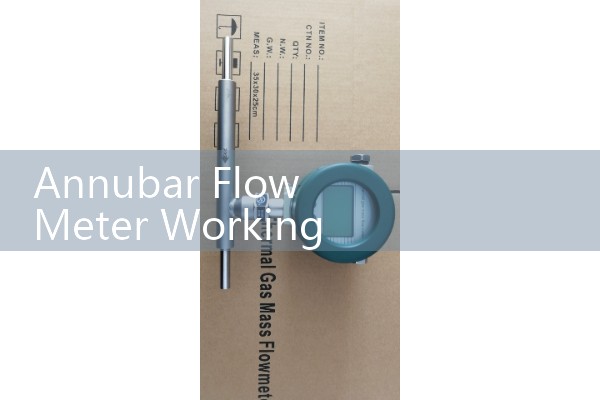
The sensor has a high pressure side that faces the flow. The rear side senses the low pressure zone. Each port measures a local velocity pressure. The high pressure chamber averages all upstream port pressures. The low pressure chamber averages all rear port pressures. The DP transmitter gets one stable average differential pressure value.
You weld a mounting fitting to the pipe. You insert the sensor through the fitting. You align the high pressure side with the flow direction. The arrow on the sensor head points downstream. Most engineers skip this alignment step. Wrong alignment shifts accuracy. We have seen this on customer sites many times.
Averaging Flow Profile Mathematics
The port positions use equal area, log-linear, or Chebyshev methods. For a DN200 pipe, typical design may select four ports on each side of the sensor. Each port represents a specific annular area inside the pipe. Equal area spacing is common for general liquid and steam service. Chebyshev spacing works better for gas lines with Reynolds number changes.
The flow calculation follows the Bernoulli equation. Q is flow rate. K is the thermal expansion factor. C is the discharge coefficient. Delta P is the averaged differential pressure. Fluid density is rho. The relation is Q equals K times C times the square root of delta P divided by rho. The transmitter performs this calculation and outputs a 4-20 mA HART signal.
Because the sensor averages multiple points, short term pulsation and profile distortion have less effect. The average pressure is more stable than a single point reading. In practice a flow meter installed after a long straight run will perform within plus or minus 1 percent of rate. With a flow conditioner or wet calibration, some applications reach better results.
Installation, Straight Run, and Accuracy
Straight run requirements matter. We recommend 10 pipe diameters upstream and 5 pipe diameters downstream. With a control valve upstream, use 20 pipe diameters or install a flow conditioner. A short straight run does not make the flow meter useless, but it adds uncertainty. For low pressure compressed air the effect is larger.
Here is a practical example. A gas processing plant in Indonesia needed to measure compressed natural g
Because the sensor is insertion type, permanent pressure loss is much lower than an orifice plate. The low pressure loss matters for large pipes and low pressure gas systems. In a DN400 compressed air line, an orifice plate wastes energy every day. An Annubar style sensor reduces compressor energy cost over the life of the plant.
Common Applications and Material Selection
Common applications include steam boiler feed, natural gas distribution, compressed air, cooling water, and seawater desalination plant feed lines. A customer in Vietnam purchased a seawater flow meter for a desalination plant where the brine line used Hastelloy C276. A food ingredients factory in the Philippines required a sanitary option for clean water with a 316L body.
Oil and gas sites often need an ATEX Zone 1 DP transmitter. Chemical plants may request PTFE coated sensors for acidic liquids. Power plants measure superheated steam with high temperature designs. Silver Instruments configures the material and transmitter for each application.
Technical Specifications and Quotation
Technical ranges cover pipe sizes from DN50 to DN1800. Process temperature can reach 400 °C with the correct material and transmitter manifold. Pressure rating goes up to PN100 or Class 600 depending on the mounting fitting. Wetted materials include 316L stainless steel and Hastelloy C276. Output options include 4-20 mA HART, RS485 Modbus, and pulse. The DP transmitter can show instantaneous flow, total flow, pressure, and temperature.
Price depends on pipe size, material, transmitter type, and whether you need a hot tap insertion. Send us your pressure in bar, temperature in °C, pipe size in DN, and flow range. Silver Automation Instruments will reply with a specific model and quotation. Call Tel: +86-25-68650347. Message WhatsApp: +86-25-52155837. WeChat: +86 15365082610.
FAQ: Annubar Flow Meter Working Principle and Selection
What is the minimum straight run for an Annubar flow meter?
We recommend 10 pipe diameters upstream and 5 pipe diameters downstream. With a control valve or a partially open valve upstream, increase to 20 pipe diameters or add a flow conditioner.
What accuracy can I expect for steam flow measurement?
Most installations achieve plus or minus 1 percent of rate for steam when the sensor is installed with the correct straight run. Wet steam or short straight runs increase uncertainty.
Which materials are available for seawater or chemical service?
316L stainless steel is standard. Hastelloy C276 is available for seawater, brine, and aggressive chemicals. PTFE coated sensors are an option for acidic or scaling liquids.
Which pipe sizes does Silver Instruments cover?
We supply insertion type Annubar flow meters from DN50 to DN1800. For larger pipes we can review the application and offer a custom probe length.
How do I get a price for my application?
Send your pipe size in DN, media, pressure in bar, temperature in °C, and flow range. Our team will reply with a model and quotation. Call Tel: +86-25-68650347 or message WhatsApp: +86-25-52155837. WeChat: +86 15365082610.