

 Current position > Product detail
『Oil Flow Meter 100 bar: Specialized Equipment Rules for Hydro-Testing Rigs』Related information(flow rotameter|digital flow meter|balo meter|hydraulic flow meter|volumetric meter|positive displacement meter|pitot tube flow meter|displacement meter|cfm meter|variable area flow meter|inline flow meter|differential pressure flow meter|calibrated flow meter|velocity meter|paddle wheel flow meter|oval gear flow meter|anemometer hvac|multiphase flow meter|doppler flow meter|thorpe tube flowmeter|heat flow meter)
Oil Flow Meter 100 bar: Specialized Equipment Rules for Hydro-Testing Rigs
Quick Answer: For hydro-testing rigs that operate at a steady 100 bar, a positive displacement oil flow meter with a stainless steel body and FKM seals gives you the most reliable measurement. Silver Automation Instruments supplies oval gear flow meters rated for 100 bar as standard, with higher pressure options up to 250 bar available on request. This design handles hydraulic oil viscosity swings and outputs a clean 4-20 mA HART signal that connects straight to your PLC.
The Real Challenge with Oil Flow at 100 bar
Most flow meters on a typical distributor shelf cannot survive a hydro-testing environment. A standard turbine meter rated for 40 bar will crack its housing at 100 bar. The seals push out. The threaded connections weep hydraulic oil across the test bay floor. We have seen this on customer sites in Vietnam and Indonesia, where a local hydraulic workshop tried to use a cheap water meter on a Shell Tellus oil test stand and ended up with a safety hazard.
Hydro-testing rigs pressurize assemblies with hydraulic oil or water-glycol mixtures up to 100 bar and hold that pressure while logging flow. The meter sits right in the high-pressure line. Any internal leak path equals a failed test log and lost time. That is why the meter body must be a single machined block of 316L stainless steel or heavy-wall carbon steel, not a thin cast housing.
Material and Seal Selection No One Should Skip
At 100 bar you need a flow meter with a minimum pressure rating of PN160. The wetted parts must resist phosphate ester fluids and standard hydraulic oils like ISO VG 32 or 46. Silver Automation Instruments builds its oil flow meters with 316L stainless steel as the default measuring chamber. Seal materials are FKM (Viton) for temperatures from -10 degC to 120 degC. For aggressive fluids we use PTFE seals. In practice, most hydro-testing engineers choose FKM because it stays elastic under pressure cycling and does not swell in mineral oil.
Pipe sizes in test rigs are often DN10, DN15, or DN20. An oval gear meter with a DN15 connection and a flow range of 2 to 100 L/h covers many small-bore hydrostatic test loops. For larger test benches that push 500 to 3000 L/h we offer a DN25 or DN40 meter. Every single unit gets a hydrostatic pressure test at 1.5 times the rated pressure on our production line before shipment.
Silver Instruments Oval Gear Meter Series OG
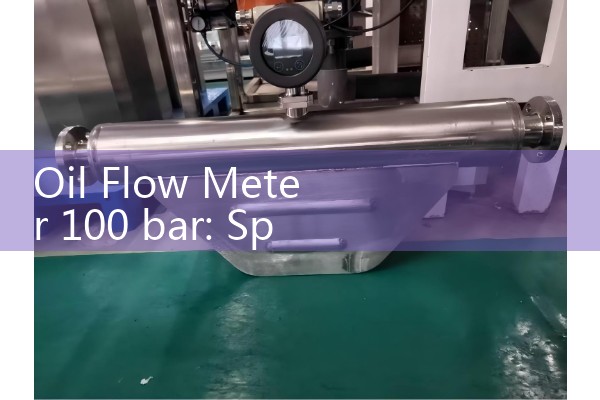
The OG series positive displacement flow meter is the workhorse for hydraulic test bench applications. Standard models carry a 100 bar operating pressure rating. We can deliver 250 bar versions with a high-pressure flanged connection for deep-sea valve test rigs that run at 200 bar. Output signals include a 4-20 mA HART transmitter with a local LCD display, a raw pulse output for batch control, and optional ATEX Zone 1 certification for test cells that handle flammable fluids.
Last year a hydraulic repair centre in Malaysia asked us for a flow meter to monitor the pump output on a hydro-testing skid. They needed to check flow at exactly 85 bar with ISO 46 oil at 40 degC. We supplied an OG-S-15 oval gear meter with a 4-20 mA HART output. They bolted it straight into the high-pressure manifold, and it has been logging flow without a single leak since. The accuracy in that range is 0.5% of reading across a 10:1 turndown.
Installation Rules That Keep the Meter Alive at 100 bar
High pressure does not forgive a dirty pipe. Place a 10-
For electronic noise, run the 4-20 mA signal cable in a separate grounded conduit. Do not bundle it with high-voltage pump motor cables. We recommend a shield drain wire connected only at the PLC end. The local display on the meter also shows instantaneous flow rate and totalized volume, so your operator can verify the reading without walking back to the control room.
Why Engineers Choose Silver Automation Instruments
We are a specialized flow meter manufacturer supplying industrial users across Southeast Asia, Oceania, Latin America, Africa, and the Middle East. When you contact us directly, you talk to an application engineer who knows how an oval gear meter behaves with hydraulic oil at 100 bar. We do not route your inquiry through three layers of general sales.
Our factory keeps standard 100 bar oil flow meters in stock with DN10 to DN40 connections. We can ship with express freight to Lagos, Surabaya, or Brisbane within a few working days. Every meter comes with a factory calibration certificate traceable to ISO 17025. Send us your pressure (bar), temperature (degC), pipe size (DN), and flow range. You will get a specific model recommendation and a firm price within 24 hours.
Frequently Asked Questions
1. What type of flow meter works best for oil at 100 bar on a hydro-testing rig?
Positive displacement oval gear meters are the safest choice. They handle high pressure, deliver repeatable accuracy independent of viscosity changes in the oil, and provide a robust all-metal measuring chamber that tolerates small particles if you install a proper strainer.
2. Can the same flow meter measure oils with different viscosity?
Yes. Oval gear meters maintain 0.5% accuracy across a wide viscosity range, from thin hydraulic oil of 10 cP up to heavy gear oil of 1000 cP. The pressure rating stays constant regardless of the oil grade flowing through the meter.
3. Does Silver Instruments offer ATEX-certified oil flow meters for high-pressure testing?
We supply ATEX Zone 1 and Zone 2 certified oval gear meters with 100 bar pressure rating for hydro-testing rigs that handle flammable fluids. The certification covers both the meter and the built-in 4-20 mA HART transmitter.
4. What output signal do I need to connect the flow meter to a PLC or data logger?
Most test rigs use a 4-20 mA HART signal with a two-wire loop. It carries both the flow rate and device diagnostics over a single cable pair. If your PLC needs pulse input, we configure the meter with a dual-channel pulse output and set the K-factor to match your controller logic.
5. How do I size the meter correctly for my hydraulic test bench?
Give us the minimum and maximum flow rate in L/h or kg/h, the operating pressure, the oil type, and the ambient temperature. We calculate the correct meter body size and ensure the pressure drop across the meter stays below 0.5 bar at your peak flow. A meter that is too large loses low-flow accuracy. One that is too small causes excessive pressure drop and may cavitate.